Authentication for clients
Last updated: Nov 3, 2026
The Fluid Attacks platform only uses SSO with Bitbucket, Google, and Microsoft Accounts.
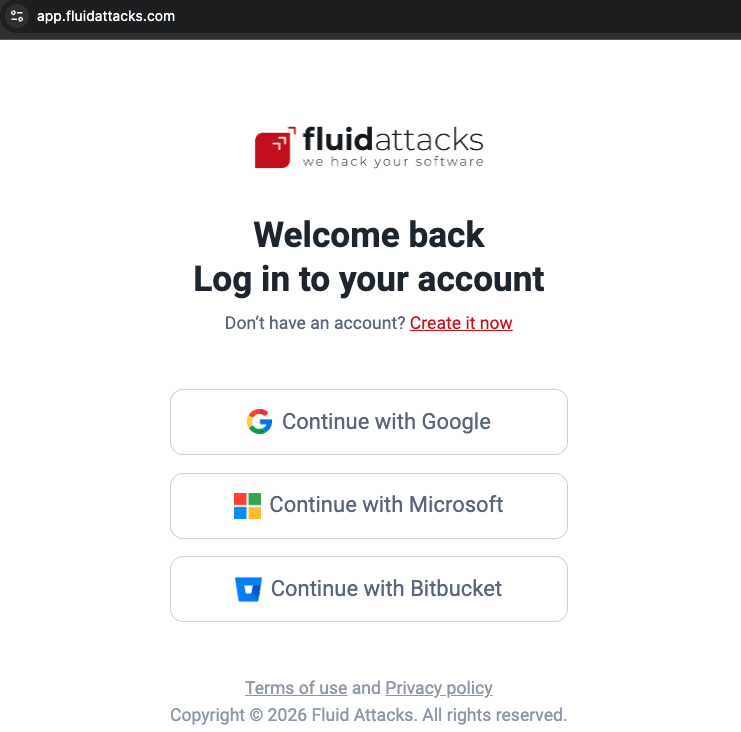
The Fluid Attacks platform uses the OAuth 2.0 protocol. OAuth 2.0 is an industry-standard authorization framework with strong security. It only accepts login attempts from trusted URLs, and it gives industry-standard 2048-byte access tokens. The Fluid Attacks platform integrates JSON Web Tokens (JWT) with the OAuth 2.0 protocol to add a layer of security. JWT uses secure algorithms to generate and verify tokens.
Fluid Attacks uses JWT with secure algorithms, for example:
- ES512 (ECDSA with SHA-512): A strong asymmetric algorithm that uses ECDSA (Elliptic Curve Digital Signature Algorithm) with SHA-512 to sign tokens with digital signatures.
- RS512 (RSA with SHA-512): A strong asymmetric algorithm that uses RSA public/private key pairs with SHA-512 to sign tokens with digital signatures.
With JWT and these secure algorithms, Fluid Attacks keeps the highest level of protection against unauthorized access and data tampering.
Fluid Attacks does not store account passwords. Fluid Attacks stores only this personal information about its clients:
- Email address
- Full name (from Google, Microsoft, or Bitbucket)
- Company name and cell phone number (only if the user shares them)
If users lose their corporate email, they also lose access to their account on the Fluid Attacks platform. Also, customers can easily control who has access to their projects.
Fluid Attacks is committed to a secure and reliable environment for its users. Its use of OAuth 2.0 with JWT and these strong, secure algorithms shows its commitment to keep user data safe and to give secure access to the Fluid Attacks platform.
Requirements
These Fluid Attacks requirements apply to the controls on this page: