Skip to Content
logo

Docs

  • Home
  • Quick start
    • FAQ
      • Billing
      • Integrations
      • Platform
      • Scanner
      • Ask our pentesters to explain a vulnerability
      • Fix code with gen AI from the IDE
      • See safe dependency versions
      • Import repositories to test
      • Invite team members to sign up
      • Billing for the Advanced plan
      • Continuous Hacking free trial, plans and pricing
      • Continuous Hacking methodology
      • Continuous Hacking PoV
      • CVSSF metric
      • Glossary
      • Main website
      • Platform demo
      • Tutorial videos
      • What is DAST?
      • What is SAST?
      • What is SCA?
      • Assign vulnerability remediation to a team member
      • See details of the reported security vulnerabilities
    • Sign up to Fluid Attacks
      • Break the build
      • Install CI Gate to break the build
      • Verify whether a fix was successful
  • Find and fix
    • Use the platform
        • Sign-up and login
        • Interface and sections
        • Create and delete groups
        • Create another organization
        • Know your Groups section
        • Manage a group's configuration
        • Register payment information
        • See the target of evaluation's status and SBOM
        • Sort groups into portfolios
        • Invite contributing developers
        • Manage members
        • Manage your organization's authors
        • Understand roles
        • Import repositories fast and safely with OAuth
        • Manage environments
        • Manage repositories
        • Manage your credentials
        • Resolve events impeding tests
        • See retrieved repositories not yet added to any group
        • Analyze your supply chain security
        • Assign treatments
        • Correlate your threat model to vulnerabilities
        • CVSS score adjustment
        • Examine the evidence of exploitability
        • Find reachable dependency vulnerabilities
        • Request a vulnerability be dismissed as Zero Risk
        • See vulnerabilities assigned to you
        • See where vulnerabilities are and more details
        • Verify fixes with reattacks
        • Vulnerability signature update
        • Ask the AI Agent
        • Ask via chat
        • Post comments
        • Send Fluid Attacks an email
        • Talk to a Pentester
        • Watch certifiable tutorial videos or get a demo
        • Vulnerability reporting
        • Standard compliance
        • ZTNA logs
        • Recent downloads
        • Common analytics
        • Organization analytics
        • Group analytics
        • Portfolio analytics
        • Charts options
        • CI Gate configuration
        • CI Gate executions
        • Security gates
        • Vulnerability acceptance
        • Prioritization attributes
        • Explore the user menu
        • Enable and disable notifications
        • Subscribe to News
        • Leave a group
      • Manage repositories
      • See vulnerabilities
        • Fluid Attacks' scanners
        • OWASP Benchmark results
        • Your feedback
      • Use the scanners
        • Local run
        • CI/CD integration
        • Understanding outputs
        • Findings exclusion
      • Use a configuration file
        • SAST scanner
        • SCA scanner
        • DAST scanner
        • APK scanner
      • Automatic remediation
      • Custom remediation guides
      • Introduction to Sorts
      • Sorts user guide
      • Connection mechanisms
      • Cloud connection
      • Egress connection
      • Connector connection
      • Types of authentication
      • AWS CodeCommit
    • Service-level agreement
      • Availability SLA
      • Response SLA
      • Accuracy SLA
      • False negatives
      • False positives
      • Scope
    • Support information
      • Changelog
        • 2023
        • 2024
        • 2025
        • 2026
      • Roadmap
      • AI functions
      • Attack surfaces
      • Binaries
      • Browsers
      • CI/CD
      • Clouds
      • CVEs for reachability
      • Evidence formats
      • Frameworks
      • IDE functionalities
      • Languages
      • Languages for fixes
      • Package managers
      • Remediation
      • SCM systems
      • Secrets
      • Standards
      • Ticketing systems
      • Documentation sections
  • Integrations
      • Local tools
      • Access Talk to a Pentester and help from Jira issues
      • Automate Jira issue creation
      • Create Jira issues for vulnerabilities
      • Go to vulnerability evidence and more from Jira issues
      • Install the Fluid Attacks app for Jira Cloud
      • Link vulnerabilities to Jira issues or unlink them
      • Request reattacks from Jira issues
      • Set up the Jira integration
      • Set up the Azure DevOps integration
      • Set up the GitLab integration
      • Install the VS Code extension
      • View vulnerable lines, use fix options and more
      • VS Code extension error and solution catalog
      • Identify and address vulnerabilities from IntelliJ
      • Install the IntelliJ plugin
      • Identify and address vulnerabilities from Cursor
      • Install the Cursor extension
      • AWS Marketplace integration
    • MCP server
      • Installation
      • Capabilities and use cases
      • Docker installation
      • Excluding files from analysis
      • Integrate with Azure DevOps Peer Reviewer Assistant
      • Integrate with GitLab Peer Reviewer Assistant
      • Troubleshooting
      • Introduction
      • Use the API
      • Learn the basics of the Fluid Attacks API
      • Things to know before using the API
  • Stack
      • Bash
      • Python
      • Terraform
      • TypeScript
      • Ariadne
      • Commitlint
      • D3
      • Docker
      • ESLint
      • GraphQL
      • Hypercorn
      • Kubernetes
      • Labels
      • Mypy
      • Nix Flakes
      • Platform audit logs
      • Platform authentication
      • Platform authorization
      • Pydantic AI
      • React
      • Ruff
      • Sops
      • Starlette
      • Tree-sitter
      • Visual Studio Code
      • AWS
      • Batch
      • Bedrock
      • BigCodeBench
      • BugSnag
      • Checkly
      • Claude 3.5 Sonnet
      • Cloudflare
      • CloudWatch
      • Cost Management
      • Datadog
      • dbt
      • DynamoDB
      • EBS
      • EC2
      • EKS
      • ELB
      • Engineering metrics
      • ePayco
      • EventBridge
      • GitLab
      • GitLab CI
      • Google Workspace
      • IAM
      • Jamf
      • KMS
      • Lambda
      • LogRocket
      • Okta
      • OpenAI
      • OpenSearch
      • Organizations
      • QuickSight
      • S3
      • SageMaker
      • Snowflake
      • Statuspage
      • Step Functions
      • Stripe
      • Treli
      • Ubiquiti
      • Vanta
      • Voyage AI
      • VPC
      • VPN
      • Zoho One
      • Zoho Sign
    • Pentesting tools
  • Compliance
    • Authentication
      • Clients
      • Password policies
      • Staff
    • Authorization
      • Access revocation
      • Clients
      • Employee termination
      • Endpoints
      • Secret rotation
      • Sessions
      • Staff
    • Availability
      • Distributed apps
      • Distributed firewall
      • Everything backed up
      • Multiple zones
      • Recovery objective
    • Confidentiality
      • Device (re)enrolling
      • Direct hiring
      • Encryption at rest
      • Encryption in transit
      • No personal gain
      • Personnel NDA
      • Secure deletion
    • Integrity
      • Applicant evaluation
      • Awareness
      • Certification Hub
      • Certified cloud provider
      • Certified security analysts
      • Comprehensive reporting
      • Developing for integrity
      • Monitoring
      • Production data isolation
      • Secure emails
      • SLSA compliance
      • Standard timezone
      • Static website
      • Training plan
    • Non-repudiation
      • Everything as code
      • Extensive logs
    • Privacy
      • Data privacy policy
      • Data retention policy
      • Data use policy
      • Email obfuscation
      • Time tracking
      • Manual for the NDR
      • OTR messaging
      • Polygraph tests
      • Project pseudonymization
      • Data transmission
      • Unsubscribe email
      • Use of cookies
    • Resilience
      • Continuity and recovery
      • Equipment and telecommuting
      • Everything is decentralized
      • Redundant roles
    • Transparency
      • Complaint management
      • Data leakage policy
      • Ethics hotline
      • Help channel
      • Incident management
      • Information security responsibility
      • Open source
      • Quality policy
      • Status page
      • Testing our technology
      • Vulnerability releasing
  • Compare
    • 42Crunch
    • 7 Way Security
    • Aikido
    • Anvil Secure
    • Apiiro
    • AppCheck
    • Appdome
    • Appknox
    • Aqua
    • ArmorCode
    • Arnica
    • Astra
    • Backslash
    • Base4
    • Bishop Fox
    • Black Duck
    • Black Hills
    • Breachlock
    • Bright Security
    • Burp Suite
    • Checkmarx
    • CloudGuard
    • Cobalt
    • Codacy
    • Conviso
    • Cure53
    • Cycode
    • Cyver
    • Data Theorem
    • DataDog
    • DeepSource
    • DefectDojo
    • Detectify
    • Devel
    • Dynatrace
    • Edgescan
    • Endor Labs
    • Escape
    • Evolve Security
    • Faraday Security
    • FortiDevSec
    • Fortify
    • GitHub Advanced Security (GHAS)
    • GitLab Ultimate
    • GuardRails
    • HackerOne
    • Hackmetrix
    • Hadrian
    • HCL AppScan
    • Heeler
    • Hopper Security
    • ImmuniWeb
    • Inspectiv
    • Intigriti
    • Intruder
    • Invicti
    • JFrog
    • Jit
    • Kiuwan
    • Legit Security
    • Mandiant
    • Mend
    • Mindgard
    • Moderne
    • NetSPI
    • NowSecure
    • Nucleus Security
    • Oligo Security
    • Orca Security
    • Oversecured
    • OX Security
    • Phoenix Security
    • PlexTrac
    • Praetorian
    • Prancer
    • Prisma Cloud
    • Probely
    • Prowler
    • ReversingLabs
    • RunSybil
    • Safety
    • Securitum
    • Seemplicity
    • Semgrep
    • Snyk
    • Socket
    • SonarQube
    • Sonatype Lifecycle
    • SOOS
    • StackHawk
    • Strike
    • Synacktiv
    • Tenable Nessus
    • ThreatModeler
    • Veracode
    • White Jaguars
    • Wiz
    • Xygeni
    • ZAP
    • ZeroPath

  • Log in to the platform 
  • Home
  • Quick start
    • FAQ
      • Billing
      • Integrations
      • Platform
      • Scanner
      • Ask our pentesters to explain a vulnerability
      • Fix code with gen AI from the IDE
      • See safe dependency versions
      • Import repositories to test
      • Invite team members to sign up
      • Billing for the Advanced plan
      • Continuous Hacking free trial, plans and pricing
      • Continuous Hacking methodology
      • Continuous Hacking PoV
      • CVSSF metric
      • Glossary
      • Main website
      • Platform demo
      • Tutorial videos
      • What is DAST?
      • What is SAST?
      • What is SCA?
      • Assign vulnerability remediation to a team member
      • See details of the reported security vulnerabilities
    • Sign up to Fluid Attacks
      • Break the build
      • Install CI Gate to break the build
      • Verify whether a fix was successful
  • Find and fix
    • Use the platform
        • Sign-up and login
        • Interface and sections
        • Create and delete groups
        • Create another organization
        • Know your Groups section
        • Manage a group's configuration
        • Register payment information
        • See the target of evaluation's status and SBOM
        • Sort groups into portfolios
        • Invite contributing developers
        • Manage members
        • Manage your organization's authors
        • Understand roles
        • Import repositories fast and safely with OAuth
        • Manage environments
        • Manage repositories
        • Manage your credentials
        • Resolve events impeding tests
        • See retrieved repositories not yet added to any group
        • Analyze your supply chain security
        • Assign treatments
        • Correlate your threat model to vulnerabilities
        • CVSS score adjustment
        • Examine the evidence of exploitability
        • Find reachable dependency vulnerabilities
        • Request a vulnerability be dismissed as Zero Risk
        • See vulnerabilities assigned to you
        • See where vulnerabilities are and more details
        • Verify fixes with reattacks
        • Vulnerability signature update
        • Ask the AI Agent
        • Ask via chat
        • Post comments
        • Send Fluid Attacks an email
        • Talk to a Pentester
        • Watch certifiable tutorial videos or get a demo
        • Vulnerability reporting
        • Standard compliance
        • ZTNA logs
        • Recent downloads
        • Common analytics
        • Organization analytics
        • Group analytics
        • Portfolio analytics
        • Charts options
        • CI Gate configuration
        • CI Gate executions
        • Security gates
        • Vulnerability acceptance
        • Prioritization attributes
        • Explore the user menu
        • Enable and disable notifications
        • Subscribe to News
        • Leave a group
      • Manage repositories
      • See vulnerabilities
        • Fluid Attacks' scanners
        • OWASP Benchmark results
        • Your feedback
      • Use the scanners
        • Local run
        • CI/CD integration
        • Understanding outputs
        • Findings exclusion
      • Use a configuration file
        • SAST scanner
        • SCA scanner
        • DAST scanner
        • APK scanner
      • Automatic remediation
      • Custom remediation guides
      • Introduction to Sorts
      • Sorts user guide
      • Connection mechanisms
      • Cloud connection
      • Egress connection
      • Connector connection
      • Types of authentication
      • AWS CodeCommit
    • Service-level agreement
      • Availability SLA
      • Response SLA
      • Accuracy SLA
      • False negatives
      • False positives
      • Scope
    • Support information
      • Changelog
        • 2023
        • 2024
        • 2025
        • 2026
      • Roadmap
      • AI functions
      • Attack surfaces
      • Binaries
      • Browsers
      • CI/CD
      • Clouds
      • CVEs for reachability
      • Evidence formats
      • Frameworks
      • IDE functionalities
      • Languages
      • Languages for fixes
      • Package managers
      • Remediation
      • SCM systems
      • Secrets
      • Standards
      • Ticketing systems
      • Documentation sections
  • Integrations
      • Local tools
      • Access Talk to a Pentester and help from Jira issues
      • Automate Jira issue creation
      • Create Jira issues for vulnerabilities
      • Go to vulnerability evidence and more from Jira issues
      • Install the Fluid Attacks app for Jira Cloud
      • Link vulnerabilities to Jira issues or unlink them
      • Request reattacks from Jira issues
      • Set up the Jira integration
      • Set up the Azure DevOps integration
      • Set up the GitLab integration
      • Install the VS Code extension
      • View vulnerable lines, use fix options and more
      • VS Code extension error and solution catalog
      • Identify and address vulnerabilities from IntelliJ
      • Install the IntelliJ plugin
      • Identify and address vulnerabilities from Cursor
      • Install the Cursor extension
      • AWS Marketplace integration
    • MCP server
      • Installation
      • Capabilities and use cases
      • Docker installation
      • Excluding files from analysis
      • Integrate with Azure DevOps Peer Reviewer Assistant
      • Integrate with GitLab Peer Reviewer Assistant
      • Troubleshooting
      • Introduction
      • Use the API
      • Learn the basics of the Fluid Attacks API
      • Things to know before using the API
  • Stack
      • Bash
      • Python
      • Terraform
      • TypeScript
      • Ariadne
      • Commitlint
      • D3
      • Docker
      • ESLint
      • GraphQL
      • Hypercorn
      • Kubernetes
      • Labels
      • Mypy
      • Nix Flakes
      • Platform audit logs
      • Platform authentication
      • Platform authorization
      • Pydantic AI
      • React
      • Ruff
      • Sops
      • Starlette
      • Tree-sitter
      • Visual Studio Code
      • AWS
      • Batch
      • Bedrock
      • BigCodeBench
      • BugSnag
      • Checkly
      • Claude 3.5 Sonnet
      • Cloudflare
      • CloudWatch
      • Cost Management
      • Datadog
      • dbt
      • DynamoDB
      • EBS
      • EC2
      • EKS
      • ELB
      • Engineering metrics
      • ePayco
      • EventBridge
      • GitLab
      • GitLab CI
      • Google Workspace
      • IAM
      • Jamf
      • KMS
      • Lambda
      • LogRocket
      • Okta
      • OpenAI
      • OpenSearch
      • Organizations
      • QuickSight
      • S3
      • SageMaker
      • Snowflake
      • Statuspage
      • Step Functions
      • Stripe
      • Treli
      • Ubiquiti
      • Vanta
      • Voyage AI
      • VPC
      • VPN
      • Zoho One
      • Zoho Sign
    • Pentesting tools
  • Compliance
    • Authentication
      • Clients
      • Password policies
      • Staff
    • Authorization
      • Access revocation
      • Clients
      • Employee termination
      • Endpoints
      • Secret rotation
      • Sessions
      • Staff
    • Availability
      • Distributed apps
      • Distributed firewall
      • Everything backed up
      • Multiple zones
      • Recovery objective
    • Confidentiality
      • Device (re)enrolling
      • Direct hiring
      • Encryption at rest
      • Encryption in transit
      • No personal gain
      • Personnel NDA
      • Secure deletion
    • Integrity
      • Applicant evaluation
      • Awareness
      • Certification Hub
      • Certified cloud provider
      • Certified security analysts
      • Comprehensive reporting
      • Developing for integrity
      • Monitoring
      • Production data isolation
      • Secure emails
      • SLSA compliance
      • Standard timezone
      • Static website
      • Training plan
    • Non-repudiation
      • Everything as code
      • Extensive logs
    • Privacy
      • Data privacy policy
      • Data retention policy
      • Data use policy
      • Email obfuscation
      • Time tracking
      • Manual for the NDR
      • OTR messaging
      • Polygraph tests
      • Project pseudonymization
      • Data transmission
      • Unsubscribe email
      • Use of cookies
    • Resilience
      • Continuity and recovery
      • Equipment and telecommuting
      • Everything is decentralized
      • Redundant roles
    • Transparency
      • Complaint management
      • Data leakage policy
      • Ethics hotline
      • Help channel
      • Incident management
      • Information security responsibility
      • Open source
      • Quality policy
      • Status page
      • Testing our technology
      • Vulnerability releasing
  • Compare
    • 42Crunch
    • 7 Way Security
    • Aikido
    • Anvil Secure
    • Apiiro
    • AppCheck
    • Appdome
    • Appknox
    • Aqua
    • ArmorCode
    • Arnica
    • Astra
    • Backslash
    • Base4
    • Bishop Fox
    • Black Duck
    • Black Hills
    • Breachlock
    • Bright Security
    • Burp Suite
    • Checkmarx
    • CloudGuard
    • Cobalt
    • Codacy
    • Conviso
    • Cure53
    • Cycode
    • Cyver
    • Data Theorem
    • DataDog
    • DeepSource
    • DefectDojo
    • Detectify
    • Devel
    • Dynatrace
    • Edgescan
    • Endor Labs
    • Escape
    • Evolve Security
    • Faraday Security
    • FortiDevSec
    • Fortify
    • GitHub Advanced Security (GHAS)
    • GitLab Ultimate
    • GuardRails
    • HackerOne
    • Hackmetrix
    • Hadrian
    • HCL AppScan
    • Heeler
    • Hopper Security
    • ImmuniWeb
    • Inspectiv
    • Intigriti
    • Intruder
    • Invicti
    • JFrog
    • Jit
    • Kiuwan
    • Legit Security
    • Mandiant
    • Mend
    • Mindgard
    • Moderne
    • NetSPI
    • NowSecure
    • Nucleus Security
    • Oligo Security
    • Orca Security
    • Oversecured
    • OX Security
    • Phoenix Security
    • PlexTrac
    • Praetorian
    • Prancer
    • Prisma Cloud
    • Probely
    • Prowler
    • ReversingLabs
    • RunSybil
    • Safety
    • Securitum
    • Seemplicity
    • Semgrep
    • Snyk
    • Socket
    • SonarQube
    • Sonatype Lifecycle
    • SOOS
    • StackHawk
    • Strike
    • Synacktiv
    • Tenable Nessus
    • ThreatModeler
    • Veracode
    • White Jaguars
    • Wiz
    • Xygeni
    • ZAP
    • ZeroPath

  • Log in to the platform 

On This Page

  • Analytics and reporting
  • Get organization analytics
  • Get group analytics
  • Vulnerability discovery and management
  • Find weaknesses in a group
  • Find specific vulnerabilities
  • Get vulnerability details
  • Get a vulnerability report
  • Get a vulnerability overview
  • Asset discovery (roots)
  • View Git repositories
  • View IP addresses
  • View URLs
  • View vulnerabilities by root
  • Security scanning
  • Run SCA scanner
  • Run SAST scanner
  • Run both scanners
  • DevSecOps integration
  • View CI/CD security results
  • View unsolved events
  • Knowledge Base/Documentation
  • Search articles
  • Specialized prompts
  • run_sca
  • run_sast
  • run_sca_and_sast
  • get_technology_based_remediation_strategy
  • configure_github_sca_integration
  • configure_github_sast_integration
  • configure_agents_md
  • How to use these prompts
IntegrationsMCP serverCapabilities and use cases

Capabilities and use cases

Some of our MCP capabilities are available to everyone (no authentication required), while others are available only to authenticated users (API token required).

(a) Start chats with a mention of Fluid Attacks’ API (e.g., “Using Fluid Attacks’ API, […]”), (b) always specify whether your requests are at the group or the organization level, and (c) for requests at the group level, specify the name of the organization as well.

Analytics and reporting

Get organization analytics

Tool: get_organization_analytics

What it does: Shows security trends and metrics for your entire organization.

When to use:

  • Monthly security reviews
  • Executive reporting
  • Tracking security improvement over time

Examples of requests:

  • “Show me our ORGANIZATION_NAME’s security risk trend for the last quarter.”
  • “How has our vulnerability count changed over time in the group GROUP_NAME?”
API token required.

Get group analytics

Tool: get_group_analytics

What it does: Shows security trends and metrics for a specific group/project.

When to use:

  • Project-specific security reviews
  • Sprint planning
  • Tracking remediation progress

Examples of requests:

  • “Show the security trend for the group GROUP_NAME.”
  • “How many vulnerabilities were fixed in the group GROUP_NAME this month?”
  • “What’s the distribution of vulnerabilities in the group GROUP_NAME?”
API token required.

Vulnerability discovery and management

Find weaknesses in a group

Tool: fetch_group_weaknesses

What it does: Lists types of security issues (e.g., SQL Injection, XSS) found in your projects.

When to use:

  • Understanding what types of vulnerabilities you have
  • Planning targeted security training
  • Prioritizing remediation efforts

Examples of requests:

  • “What types of vulnerabilities exist in the group GROUP_NAME?”
  • “Show me all critical security weaknesses in the group GROUP_NAME.”
  • “List SQL injection findings across my groups.”
API token required.

Find specific vulnerabilities

Tool: fetch_weakness_vulnerabilities

What it does: Lists exact instances of vulnerabilities with their locations in your code.

When to use:

  • Assigning fixes to developers
  • Tracking specific security issues
  • Understanding where problems exist in your code

Examples of requests:

  • “Show me all XSS vulnerabilities in the frontend code repo for the group GROUP_NAME.”
  • “List untreated vulnerabilities by priority for the group GROUP_NAME.”
  • “What vulnerabilities are in the authentication module of the group GROUP_NAME?”
API token required.

Get vulnerability details

Tool: get_vulnerability_details

What it does: Shows complete information about a specific vulnerability.

When to use:

  • Investigating a security issue
  • Understanding how to fix a vulnerability
  • Reviewing a vulnerability before closing it

Examples of requests:

  • “Show me details for vulnerability VULNERABILITY_UUID.”
  • “What’s the full information on the SQL injection in login.py for the group GROUP_NAME?”
API token required.

Get a vulnerability report

Tool: get_group_weaknesses_report

What it does: Creates a comprehensive report grouping vulnerabilities by type.

When to use:

  • Security audits
  • Compliance reporting
  • Sprint planning meetings
  • Management presentations

Examples of requests:

  • “Generate a vulnerability report for the ProductionAPI group.”
  • “Show me a report of all open security issues in the group GROUP_NAME.”
  • “Create a summary of vulnerabilities by severity in the group GROUP_NAME.”
API token required.

Get a vulnerability overview

Tool: get_group_weaknesses_overview

What it does: Shows counts of vulnerabilities and weaknesses at a glance.

When to use:

  • Quick daily status checks
  • Dashboard creation
  • Priority assessment

Examples of requests:

  • “How many open vulnerabilities do we have in the group GROUP_NAME?”
  • “Give me a vulnerability count summary for the group GROUP_NAME.”
  • “What’s the current vulnerability status for the group GROUP_NAME?”
API token required.

Asset discovery (roots)

View Git repositories

Tool: get_group_git_roots

What it does: Lists source code repositories being tested for security.

When to use:

  • Verifying what code is being scanned
  • Finding specific repositories
  • Ensuring all code is covered

Examples of requests:

  • “What Git repositories are we testing?”
  • “Show me all code repositories for the group GROUP_NAME.”
  • “Is the frontend repository being scanned?”
API token required.

View IP addresses

Tool: get_group_ip_roots

What it does: Lists applications and services accessible via IP addresses being tested.

When to use:

  • Black-box testing scope verification
  • Network security assessment
  • Infrastructure testing

Examples of requests:

  • “What IP addresses are we scanning?”
  • “Show me all tested network endpoints.”
  • “List IPs being tested for the WebApp group.”
API token required.

View URLs

Tool: get_group_url_roots

What it does: Lists live websites and web applications being tested.

When to use:

  • Verifying production testing scope
  • Web application security assessment
  • Ensuring all environments are covered

Examples of requests:

  • “What websites are we testing?”
  • “Show me all URLs for the E-commerce project.”
  • “List production environments being scanned.”
API token required.

View vulnerabilities by root

Tool: fetch_group_root_vulnerabilities

What it does: Shows vulnerabilities found in a specific repository, IP, or URL.

When to use:

  • Repository-specific security review
  • Assigning work to teams responsible for specific assets
  • Understanding security issues in one part of your infrastructure

Examples of requests:

  • “What vulnerabilities are in the main-app repository?”
  • “Show me security issues for the production URL.”
  • “List vulnerabilities found in the API server IP.”
API token required.

Security scanning

Run SCA scanner

Tool: run_sca_scanner

What it does: Provides instructions to scan your project dependencies for known vulnerabilities.

When to use:

  • After adding new dependencies
  • Before releasing new versions
  • Regular security audits of libraries

Examples of requests:

  • “How do I scan my dependencies?”
  • “Run an SCA scan on this project.”
  • “Check my npm packages for vulnerabilities.”

What it scans:

  • Package.json and lock files
  • Requirements.txt and poetry files
  • Composer.json
  • pom.xml and gradle files
  • Any dependency management files

Run SAST scanner

Tool: run_sast_scanner

What it does: Provides instructions to scan your source code for security vulnerabilities.

When to use:

  • After writing new code
  • Before code reviews
  • Pre-deployment security checks

Examples of requests:

  • “How do I scan my code for vulnerabilities?”
  • “Run a SAST scan on the authentication module.”
  • “Check my Python code for security issues.”

What it finds:

  • SQL injection
  • Cross-site scripting (XSS)
  • Security misconfigurations
  • Hardcoded secrets
  • Insecure cryptography
  • And 100+ other vulnerability types

Run both scanners

Tool: run_sca_and_sast_scanners

What it does: Provides instructions to run SAST and SCA scans together.

When to use:

  • Comprehensive security assessment
  • Pre-production security gate
  • Weekly security checks

Examples of requests:

  • “Run a complete security scan.”
  • “Scan both my code and dependencies.”
  • “Do a full security assessment.”

No authentication required. However, Docker is required to run the scanners. See “Docker installation ” for more information.

DevSecOps integration

View CI/CD security results

Tool: get_devsecops_agent_executions

What it does: Shows results from automated security scans in your development pipeline.

When to use:

  • Checking build status
  • Investigating failed security gates
  • Monitoring automation effectiveness

Examples of requests:

  • “How many builds failed security checks this week for the group GROUP_NAME?”
  • “What was the result of the last Forces execution for the group GROUP_NAME?”
API token required.

View unsolved events

Tool: get_unsolved_events

What it does: Lists security incidents and situations requiring attention.

When to use:

  • Daily incident review
  • Security event management
  • Prioritizing urgent issues

Examples of requests:

  • “What security events need my attention?”
  • “Show me unsolved incidents.”
  • “List open security events.”
API token required.

Knowledge Base/Documentation

Search articles

Tool: search_related_articles

What it does: Searches Fluid Attacks’ security knowledge base for relevant information.

When to use:

  • Learning about vulnerability types
  • Finding remediation guidance
  • Understanding security concepts

Examples of requests:

  • “How to configure the SCA scanner to run on Azure DevOps?”
  • “What is cross-site scripting?”

Topics covered:

  • Vulnerability explanations
  • Remediation guides
  • Security best practices
  • Platform usage instructions
  • Compliance guidance
API token required.

Specialized prompts

The implementation of our MCP includes the following specialized prompts, which are designed to help AI agents perform security-related tasks:

run_sca

Pass the instructions to run the SCA scanner to the LLM.

Usage: /fluidattacks-mcp/run_sca

run_sast

Pass the instructions to run the SAST scanner to the LLM.

Usage: /fluidattacks-mcp/run_sast

run_sca_and_sast

Pass the instructions to run the SCA and SAST scanners to the LLM.

Usage: /fluidattacks-mcp/run_sca_and_sast

get_technology_based_remediation_strategy

Pass the technology-specific remediation guidance to the LLM.

Usage: /fluidattacksmcp/get_technology_based_remediation_strategy

This is the only prompt that requires an API token.

configure_github_sca_integration

Pass the instructions to configure the SCA scanner to run on GitHub Actions to the LLM.

Usage: /fluidattacks-mcp/configure_github_sca_integration

configure_github_sast_integration

Pass the instructions to configure the SAST scanner to run on GitHub Actions to the LLM.

Usage: /fluidattacks-mcp/configure_github_sast_integration

configure_agents_md

Configure the AGENTS.md file in the project root directory.

Usage: /fluidattacks-mcp/config_agents_md

How to use these prompts

To use Fluid Attacks MCP prompts, you start by typing the command name in the chat of your AI agent. For example, to configure the AGENTS.md file, you would type: /fluidattacks-mcp/config_agents_md
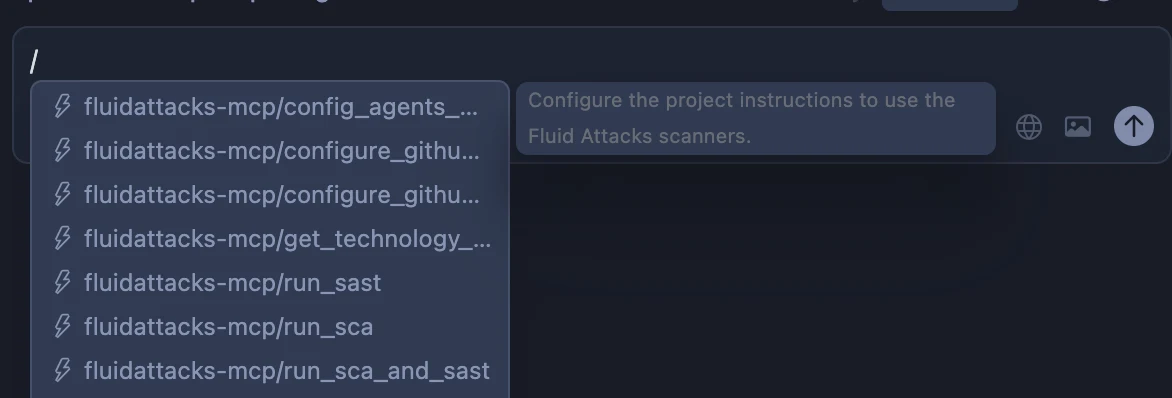
Commands to use Fluid Attacks MCP prompts

Select the command you want to use and press Enter.

Have an idea to simplify our architecture, or noticed docs that could use some love? Don’t hesitate to open an issue  or submit improvements.

Last updated on February 19, 2026
InstallationDocker installation

Fluid Attacks 2026. All rights reserved.